Technology for Leading and Learning

About Me:
My name is Abigail Jankowski but I prefer to go by Abby. I am a sophomore at the University of South Florida majoring in Elementary Education with hopes to become a kindergarten teacher. I found my passion in this major because of the love I have in my heart for helping others and being a leader in a setting like a classroom. I love to be in charge and I am very outgoing. I thrive in settings around other people where I can bounce off of their energy. I love fashion and beauty and I love talking to people. I am in a sorority here on campus, Delta Gamma, where I have grown immensely in my confidence and meeting my best friends. I have two younger siblings back at home in Vero Beach, FL. who I have grown up wanting to be a great role model for and I hope I can do that one day for my future students. I am making this blog for EME2040 or Technology for Leading and Learning where I intend on learning how to incorporate technology into a setting like one I will work in the future.
Moore’s Law:
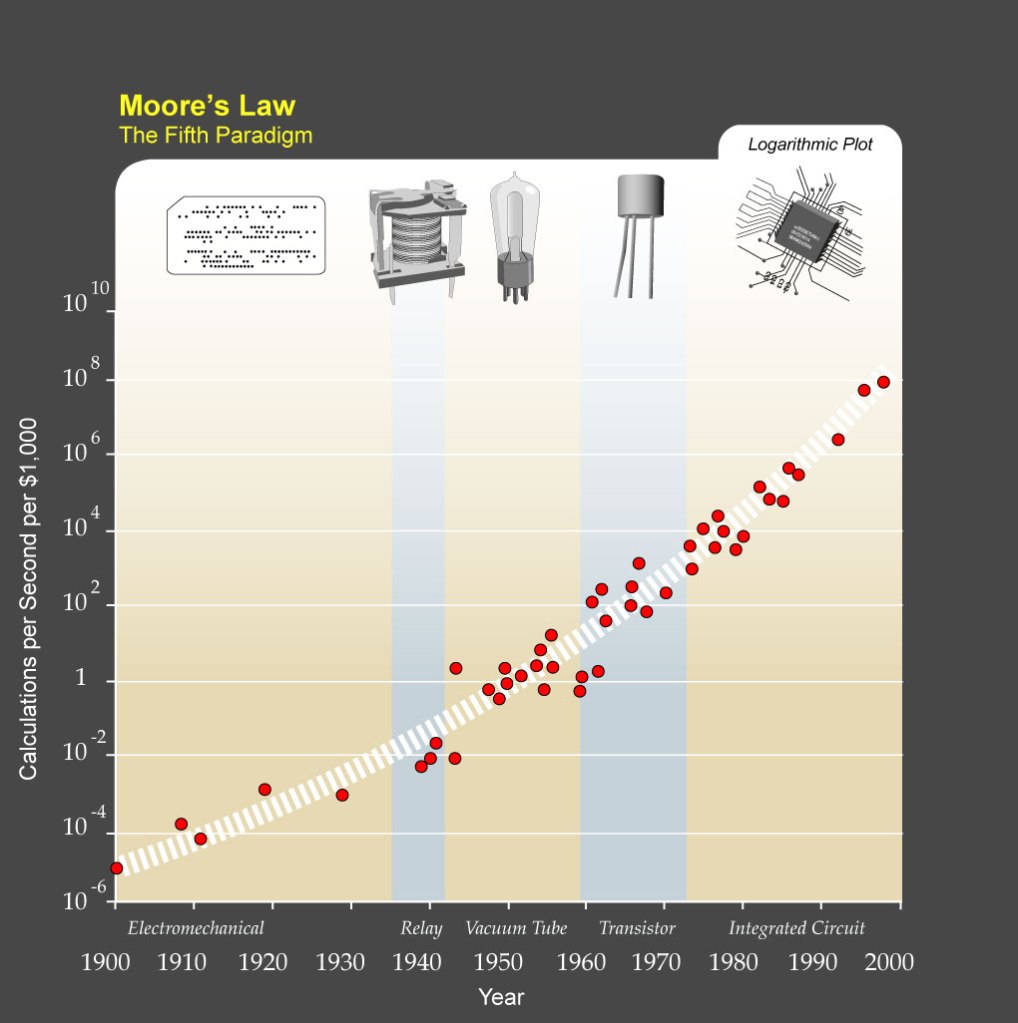
Moore’s Law refers to Gordon Moore’s perception that the number of transistors on a microchip doubles every two years, though the cost of computers is halved. The numbers of the transistors are in a dense integrated circuit. Gordon Moore was the co-founder of Fairchild Semiconductor and the CEO of intel. Moore’s predictions were accurate for several decades. The Law was created in 1965 and would continue to grow exponentially for a decade until 1975. What is most interesting to me about this law is that like mentioned in the CNET article there are no physical limits but industries like automotive do have boundaries.
Fuller’s Theory:
Richard Buckminster Fuller was born in 1895 in Massachusetts. He never graduated college so he joined the Navy and then became an architect and manufacturer. Fuller is well known for his use of technology and his inventions. He is most famous for his invention of the Dymaxion House, the Geodesic dome, and the Dymaxion car. Richard Buckminster Fuller also created the Knowledge Doubling Curve, this was a theory where he believed that while knowledge was growing and expanding it would widen at different rates of growth so that not everything was on the same level. What really stands out to me is the way that these structures are seen everywhere in places like kids’ playgrounds and in huge buildings in California and in Africa too.

Kurzweil’s Law:
Ray Kurzweil came up with a theory that had to do with the Law of Accelerating Returns. According to his studies this refers to which the rate of change in a wide variety of evolutionary systems, including but not limited to the growth of technologies, tends to increase exponentially. The Law of Accelerating Returns has altered public perception of Moore’s Law. Kurzweil’s Law focuses mainly on the common force driving technological progress forward. Kurzweil often compares the evolution of technology to biology as each technology can only stem for its predecessor, and with time the technology grows exponentially, increasing in speed, efficiency, price performance, and overall power. In this law what is interesting to me is in the way that the things we use everyday that are voice activated like “alexa” and “siri” are because of this.
Thiel’s Theory:
Peter Thiel was born in 1967 in West Germany. He worked as an entrepreneur and business executive doing things like creating paypal which some of us use everyday. He studied at Stanford University and graduated from their law school. From there he published articles on political correctness and became very successful doing so. In his End of the Future Theory he states that technological progress is starting to slow down, as we are running out of ideas. He into detail explaining how all these companies like Google and Apple have billions and billions of dollars but they do not have the knowledge to invest it into growing technologies such as biotechnology, aerospace, and advanced machines. Even with the huge acceleration in computers and internet, Thiel explains we have been in an era of stagnation which has given no thought to the future. This can cause a great deal of problems for our future.
 Abby Jankowski's Blog